
Enheduanna’s Journey
- Layshaianae
- Apr 16, 2023
- 5 min read

Article Menu
Enheduanna (2285-2250 BCE) is one of the most remarkable women who has graced this Earth, yet she has been lost in history, and very few historical scholars know her by name. As the high priestess of Ur in ancient Mesopotamian times Enheduanna has made incredible contributions to the paradigms of literature and religious iconography within the fertile crescent, eventually asserting herself in the ancient world as a deity. However, her literary accomplishments can be traced back to the roots of modern-day prayer and hymns, we can find in the bible as well as in epics such as that coming from Homer of Greece.
Assyrian Princess
Enheduanna’s Journey began when her father Sargon- Assyrian king of the first empire- appointed her to be a high priestess to the temple of Nann (a Moon God) in Ur. Anthropologists have no way of identifying Enheduanna’s original name but, “on moving to Ur, the very heartland of Sumerian culture, she took a Sumerian official title: Enheduanna - `En' (Chief Priest or Priestess); `hedu' (ornament); `Ana' (of heaven)" (Mark). In Sumerian culture it was traditional for kings to give their daughters titles such as high priestess and Sargon used this tradition in his favor as it solidified that his power would also be magnified with the spiritual and religious influence Enheduanna had as high priestess of Ur, the capital city of Sumer.
This practice allowed elite families to remain in as much political and religious power as possible ensuring that there would be little room for pushback from citizens who disapproved of Sargon’s Assyrian rule. Because Enheduanna came from the royal family she lived a very privileged lifestyle, giving her an extensive education that most Mesopotamians would not have access to, which would have immense value as she came to establish herself as one of the most notable poets in ancient times.
Political Power
Generally, Mesopotamia was made up of city-states, each with its own temple and deities, that would rule over its people. When Sargon took over as an Assyrian king ruling over the Sumerian people, he held the task of merging Sumerian and Akkadian culture to keep the peace between the people, which would not have been possible if he did not appointEnheduanna to be the high priestess of Ur.
As part of her priestly duties Enheduanna was considered to be the earthly Nigal- wife of Nanna- and held many responsibilities of taking care of the Nigal statue which resided at the heart of the temple, “Nigal’s well-being assured prosperity and abundance for the citizens of Ur and indeed for the country” (Shong Pg.15). Her duties also included the overall organization of the temple as well as ensuring spiritual soundness for the people of Ur.
During her time as a priestess, Enheduanna wrote a collection of over 42 hymns to deities all over Mesopotamia including Nippur, Ur, central lowlands, Lagash territories, Umma region, Kazallu, Marda, Akkad, and Eresh. These poems identified and personified the gods in a passionate devotion to Mesopotamian polytheistic religions. She was able to give the gods characteristics that no other priest or poet had ever before setting a new standard for who the gods were and what role they played in the human world. The first hymn in her collection was dedicated to the god Enki which served as a way to identify her father Sargon as being divinely appointed to kingship by Enki himself, ensuring their spiritual power.
Merging Sumerian & Assyrian Mythos
In her successful attempt to merge Sumerian and Akkadian cultures, Enheduanna wrote several hymns to gods residing in the holy city of Nippur which was a central location of the religious sacrament to the Sumerian people. Of the primary deities worshipped in Nippur is the god Enlil, as Nippur was considered to be not only Enlil’s resting place but the main home to the gods.
Within her poem to Enlil Enheduanna intentionally addresses both the Sumerian and Akkadian accounts of creation mythos, “The difference of creation is notable but leaves no doubt that both temples lay claim to the origins of the cosmos” (Shong Pg.44). By including both primordial events Enheduanna ensures that both the Sumerian and Akkadian people can be happy with her spiritual worship of the gods, rather than trying to force either group to assimilate into the other she intentionally creates a melting pot of both cultures.
This is extremely powerful because in Mesopotamian times religion played an important role in everyday life, so by ensuring both cultures had a say in the spiritual world she was able to reduce religious conflict by intertwining Akkadian and Sumerian mythos throughout all of her Hymns. It would be these same hymns that would inspire the Babylonians to write scriptures such as Psalms which can be found in any Bible on the market today.
In addition to writing 42 Hymns dedicated to the temples of Mesopotamia, Enheduanna also wrote 3 love poems to the goddess Inanna, “Although her works address other deities, including the moon god Nanna whom she served; she is most passionate in her devotion to Inanna.” (Mark) This collection of poems dedicated to Inanna is as follows: Inninsagurra ('The Great-Hearted Mistress), Ninmesarra (The Exaltation of Inanna), and Inninmehusa (Goddess of the Fearsome Powers).
Inanna's Affair
Not even to the god for which Enheduanna was appointed did she write so many works of poetry as she did for the goddess Ianna (goddess of fertility, love, sensuality, and war), and in her work you can sense how much passion and love Enheduanna felt for Inanna which can be seen in this excerpt from The Literature of Ancient Sumer translated by Jeremy Black, “Which god is like you in gathering together ... in heaven and earth? You are magnificent, your name is praised, you alone are magnificent! I am En-hedu-anna, the high priestess of the moon god. ...; I am the ... of Nanna.” (Mark) Enheduana calls herself out by name to ensure Ianna knows who praises her name so devoutly, even though she is quite literally betrothed to another.
It was only because Enheduanna marked her name on her writings that she is known as the world's first author. Of course, there had been other writings mostly having to do with record keeping Enheduanna would be the first to write her name in writing that was more for pleasure and passion than for keeping material valuables.
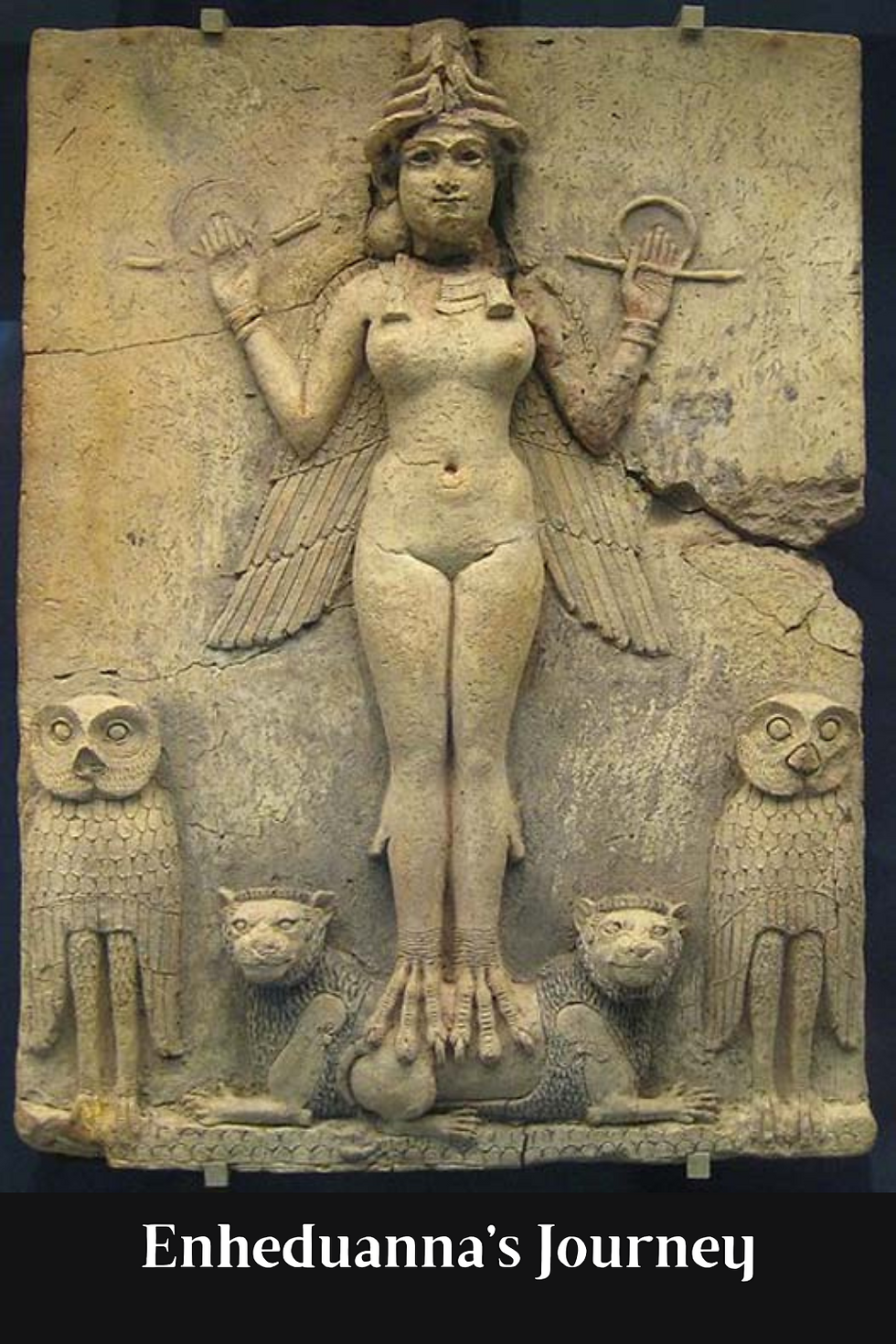
Because of her immense contributions to literature especially as it influenced the religious iconography of Mesopotamian culture Enheduanna was worshipped after death being a Nigal of Nanna and an overall powerful woman. Her likeness can be found in art and sculptures which were excavated from the temple of Ur, notably we can understand Enheduanna’ss impact on culture in The disc of Enheduanna” found in the Penn Musuem, “That the inscription on the back of the disc was copied by a scribe four hundred years after her death testifies to her legacy as a unique public historical figure.” (Shong Pg. 14).
As we reach the end of Enheduanna’s journey we have come to see how much of an influence she had had on the cultural paradigms of religious literacy and the merging of cultures, so much so that her legacy lives on today in biblical hymns that have inspired the sacred texts of the world's most popular religion. Undoubtedly Enheduanna has left her mark on the world as she continues to inspire women like me to always follow your heart no matter what position you find yourself to be in.
Citations Mark, J. J. (2022, November 18). Hymn to Inanna. World History Encyclopedia. Retrieved December 5, 2022, from https://www.worldhistory.org/article/2109/hymn-to-inanna/ Mark, J. J. (2022, December 4). Enheduanna. World History Encyclopedia. Retrieved December 6, 2022, from https://www.worldhistory.org/Enheduanna/ Shong, M. B. D., & Enheduanna. (2009). Princess, priestess, poet: The Sumerian temple hymns of Enheduanna. University of Texas Press.


Comments